

Atmospheric Infrared Sounder (AIRS)
Product Details
RESEARCH PRODUCT DETAILS
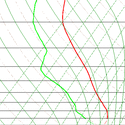
AIRS Profiles
AIRS Level-2 products can give near-rawinsonde-quality retrievals of atmospheric temperature and moisture. Currently, this is a research product in development for transition to SPoRT's Huntsville NWS WFO partner for use in detecting mid-morning pre-convective atmospheric conditions. The AIRS profiles give an asynoptic, three-dimensional look at the atmosphere that is not available through point observations such as rawinsondes or aircraft data, so they can be of used in finding the location of fronts or other changes in atmospheric stability. The real-time data is a tool that compares the AIRS soundings with NAM forecast and rawinsonde observations to help aid the researchers and forecasters in determining the best way to use the AIRS profiles for operational weather forecasting applications.
RESEARCH PRODUCT DETAILS
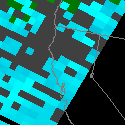
Carbon Monoxide
Carbon Monoxide (CO) is one of a number of trace gases that can be retrieved from AIRS. AIRS is capable of retrieving vertical profiles of CO at 45-km resolution (at nadir). CO is present in high concentrations in smoke from biomass burning or wildfires, which means CO may be used for wildfire, visibility, and/or public health forecasting. Because of the large spatial footprint, it is unlikely to be able to detect individual fires; however, as a means of tracking CO and smoke from fires, it can be quite effective. In addition, it provides a secondary check if a forecaster is using satellite imagery to detect smoke but is unable to discern whether a feature is smoke from a fire or clouds. Also, it could be helpful in detecting smoke at night when visible satellite imagery is unavailable. To this end, SPoRT has developed a twice-daily CO concentration product as a means for tracking smoke extent.
RESEARCH PRODUCT DETAILS
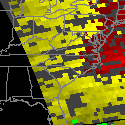
Total Ozone
Ozone (O3) is one of a number of trace gases that can be retrieved from AIRS. AIRS is capable of retrieving vertical profiles of O3 at 45-km resolution (at nadir). Total ozone is one method of tracking stratospheric ozone intrusions. In some mid-latitude and transitioning extratropical cyclones, extremely dry air from the stratosphere associated with an advection jet can get downwelled into the windward side of the storm associated with positive vorticity advection that can lead to strengthening of a storm. This product can be used in conjunction with the SPoRT RGB products to better define the magnitude and location of stratospheric air.
RESEARCH PRODUCT DETAILS
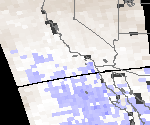
Ozone Anomaly
The AIRS Ozone Anomaly product shows the percentage departure from normal from climatology. The normal value is based on a global mean climatology derived from the Microwave Limb Sounder integrated ozone profiles constructed by Ziemke et al. (2011)1. The mean climatology is derived from data that spans a 6 year period from 2004 - 2010 and consists of zonal monthly means at 5° latitude resolution. The Anomaly product allows forecasters to pinpoint stratospheric air with the knowledge that air can be considered stratospheric when ozone values are 25% greater than climatology (Van Haver et al. 1996)2. Comparison with the RGB Air Mass product, AIRS Total Column Ozone product, and potential vorticity fields can reveal regions susceptible to stratospheric intrusions and tropopause folds (regions 125% or more shaded blue). Identifying these features can aid in forecasting cyclogenesis, non-convection winds, and suppression or promotion of convection.
1Ziemke J. R., S. Chandra, G. J. Labow, P. K. Bhartia, L. Froidevaux, J. C. Witte, 2011: A global climatology of tropospheric and stratospheric ozone derived from Aura OMI and MLS measurements. Atmospheric Chemistry and Physics, 11, 9237-9251.
2Van Haver, P. and Coauthors, 1996: Climatology of tropopause folds at midlatitudes. Geophys. Res. Lett., 23, 1033-1036.


