

RGB Products
RESEARCH
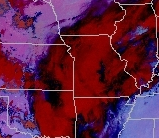
24-hour Microphysics
Used both day and night to identify low clouds and fog, low stratus, and thin cirrus through the use of the 11.0-8.7 µm brightness temperature difference.
RESEARCH
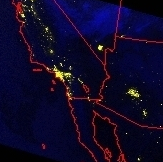
Day/Night Band Radiance RGB
RGB image that combines Day/Night radiance with the long-wave IR channel.
real-time data (CONUS)
RESEARCH
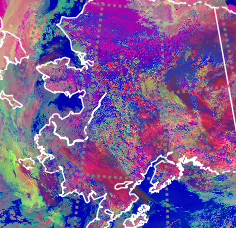
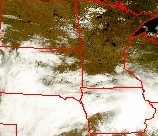
Daytime Microphysics
The daytime complement to the Nighttime Microphysics RGB to identify low clouds and fog, low stratus, and thin cirrus through the use of 3.9 µm reflectance.
real-time data (Alaska)
RESEARCH
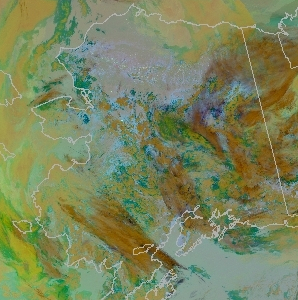
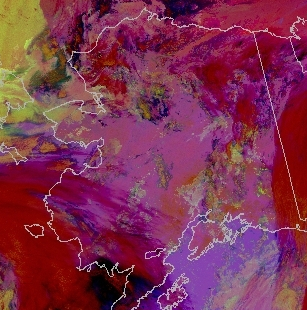
Ash
RGB used to identify volcanic ash plumes through the use of the 11.0-8.7 µm brightness temperature difference.
real-time data (Alaska)
RESEARCH
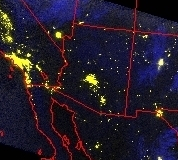
Day/Night Band Reflectance RGB
RGB image that combines Day/Night reflectance with the long-wave IR channel.
real-time data (CONUS)
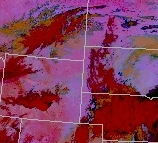
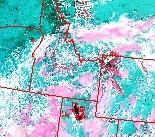
Across the NWS regions, capabilities new to operational polar satellites such as the generation of natural and false color red-green-blue (RGB) composites and the detection of atmospheric and surface features at night with the low light channel will be evaluated. The low light visible channel, enhanced from that first used on the DOD OLS, can address snow cover, airborne dust, smoke and clouds, city lights, fires and lightning at night. The VIIRS spectral channels will allow for the calculation of 6 of the 8 standard RGB composites shown by EUMETSAT and others to be of significant value in diagnostic weather analysis.
SPoRT is developing a suite of products from S-NPP in order to demonstrate future capabilities of similar instruments aboard JPSS (Table 1). JPSS will supplement visible and infrared channels currently available on GOES, those expected from the launch of GOES-R, and data available from MODIS and S-NPP if these polar orbiters remain fully functional during the JPSS era. To improve the use of additional spectral bands in the JPSS era, SPoRT is developing additional false color, or "RGB" composites from VIIRS and CrIS data to demonstrate future JPSS capabilities. Several RGB composite products have been developed by the European Organization for the Exploitation of Meteorological Satellites (EUMETSAT) with demonstrated applications for their SEVIRI instrument flown aboard Meteosat-9. EUMETSAT has developed a series of products and recipes that can be applied to combinations of VIIRS and CrIS data to demonstrate new applications of multispectral data and to prepare forecasters for the JPSS era.
| RGB Product | MODIS Channels or Differences for R,G,B | VIIRS Channels | SEVIRI Channels | Applications |
|---|---|---|---|---|
| Air Mass | 27-28, 30-31, 27 (inverted) | C6.197-C7.299*, C9.703*-M15,C6.197* (inverted) | 5-6, 8-9, 6 (inverted) | Jet Streaks, PV Analysis |
| Day/Night Band | DNB, M15 | Clouds | ||
| Daytime Convective Storms | 5-6, 4-9, 3-1 | Severe Weather, Water Vapor In/Outflow | ||
| Daytime Snow-Fog | 3, 2, 12 (solar: 4, 9, and 11) | Snow Melt, Ice Jams | ||
| Daytime Microphysics | 2, 12 (solar: 4, 9, and 11), 9 | Convective, Fog, Fire | ||
| Dust | 32-31, 31-29, 31 | M16-M15, M15-M14, M15 | 10-9, 9-7, 9 | Differential Dust from Cloud |
| Natural Color (Land Cover) | 3, 2, 1 | Ice/Water Cloud, Vegetation | ||
| Nighttime Microphysics | 32-31, 31-20, 31 | M16-M15, M15-M12, M15 | 10-9, 9-4, 9 | Fog/Low Stratus, Thin Cirrus |
| Snow/Cloud | 3, 6, 7 | M3, M10, M11 | Snow, ice, clouds | |
| True Color | 1, 4, 3 | M5, M4, M3 | Smoke, Land Surface Changes | |
| * C6.197, C7.299, and C9.703 are corresponding channels from CrIS | ||||
