

Cooperative Institute for Research in the Atmosphere's Precipitable Water Product Details
EVALUATION PRODUCT DETAILS
Layered Precipitable Water
The CIRA LPW, or Layered Precipitable Water, is a microwaved-based precipitable water product that separates the PW values into discrete layers. The product combines Microwave Integrated Retrieval System (MIRS) retrievals produced operationally at NOAA/NESDIS from NOAA-18, NOAA-19, Metop-A, and DMSP F-18 and AIRS Version 6 retrievals made available via the NASA Land Atmospheric Near real-time Capability for EOS (LANCE) system (Kidder and Jones, 2007). Coverage for LPW is near-global, and the product is updated with new swath information every three hours. The product suite is composed of total column-integrated precipitable water and precipitable water values in four individual layers: surface-850 mb, 850-700 mb, 700-500 mb, and 500-300 mb.
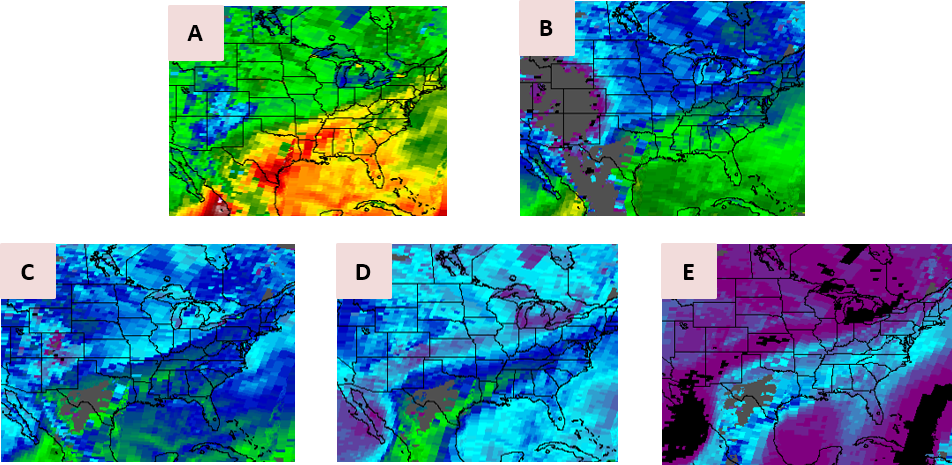
Figure 2. Example of the Total Column Precipitation product and the individual layers produced by CIRA's Layered PW product suite. (A) Total LPW product. (B) Surface to 850mb LPW product. (C) 850 mb to 700 mb LPW product. (D) 700 mb to 500 mb LPW product. (E) 500 mb to 300 mb LWP product.
