Product Training Modules
Training is a major component of SPoRT's philosophy of not "throwing data over the fence." SPoRT works closely with our collaborative partners to determine the effectiveness of transitioned products. Below are the web-based training modules produced by SPoRT to allow forecasters to review training at their leisure. Training with audio uses a large amount of bandwidth and it is recommended that users with lower bandwidth ratings use the "Download" feature, when available, instead of streaming the training online.
For more information, see the Training Program Overview at the bottom of this page.
TRAINING
VIIRS
- Download PDF (.7 MB)
- Author: Anita LeRoy
This quick reference guide describes the VIIRS instrument and its capabilities. Users become familiar with VIIRS through a comparison to MODIS imagery. The VIIRS product suite provided by SPoRT is listed. Example "Hybrid" and RGB composite imagery are provided to illustrate the benefits of VIIRS resolution and increased swath width. (March 2013)
TRAINING
RGB Air Mass
- Download PDF (.6 MB)
- Author: Kevin Fuell
A 2-page reference document describes the fundamental aspects of the Air Mass RGB Imagery product and it demonstrates color interpretation of the multi-channel imagery. The RGB composite is based on the EUMETSAT RGB guidelines, and these are applied using MODIS channels. The imagery is often applied to identifying jet streaks and associated areas of potential vorticity, in addition to differentiating large scale air masses. This Quick Guide style is intended to help users recall important aspects of the product and can be placed on a local intranet or a job aid sheet in operations for easy access. (May 2012)
TRAINING
RGB Nighttime Microphysics
- Download PDF (1 MB)
- Author: Kevin Fuell
A 3-page reference document describes the fundamental aspects of the Night-time Microphysics RGB Imagery product. Included are two examples: a coastal event, and a multi-cloud scene. This MODIS RGB imagery uses the common IR spectral difference for fog/low cloud detection as well as inputs related to optical thickness and the cloud's thermal property (see EUMETSAT standards) in order to help differentiate low clouds and near-surface fog. This Quick Guide style is intended to help users recall important aspects of the product and can be placed on a local intranet or a job aid sheet in operations for easy access. (May 2012)
TRAINING
Convective Initiation (CI) GOES-R Proxy Algorithm
- by University of Alabama Huntsville
- * 2011 Tele-training with developers (wmv file; 33.4 MB; Oct. 2011)
NOTE: The recorded training session is 17 minutes in length. The remaining 21 minutes is a Q&A discussion with the UAH developers.
- * Supplemental training for CI Strength of Signal product (PDF; 5.8 MB, October 2012).
NOTE: The above tele-training is a pre-requisite to this supplemental training.
The CI tele-training session discusses the motivation behind a Convective Initiation product as well the 6 "interest fields" derived from present GOES. Previously, a day-time product only, the CI product has been adapted for night-time and improvements for this period are ongoing. The Supplemental training PDF discussed the next version of the product, referred to as a "Strength of Signal" index. This is a direct result of forecaster feedback from the 2011 HWT and WFO evaluations. This version is the first step toward providing true probabilistic forecasts of near-future CI. Because the previous version used a set of "one size fits all" thresholds to make "YES/NO" CI forecasts, there was not enough information provided for a forecaster about the true likelihood of near-future CI. A database of "CI' and "Non-CI" events has been developed in order to statistically compare the cloud-top characteristics of convective form clouds that go on to produce CI with those that do not produce CI.
TRAINING
Pseudo Geostationary Lightning Mapper
- Download (for NWS users; 14 MB)
- Launch in browser
(user guide)
This module is an update to the original 2010 training module with new information, graphics, and content. This module introduces SPoRT's Pseudo Geostationary Lightning Mapper Flash Extent Density product and variants for use in the GOES-R Proving Ground. The Pseudo GLM is intended as a training product for forecasters ahead of the GOES-R era and to prepare forecasters for the more robust GLM Proxy product under development by the Algorithm Working Group. Experts with total lightning and the GLM have contributed to this module that provides brief overviews of total lightning and the actual GLM instrument. Additionally, the Pseudo GLM is described and examples of its use are provided. As this module is intended for preparation for GOES-R Proving Ground activities, particularly the Hazardous Weather Testbed's Spring Program the length is a little longer than most SPoRT modules. This module is 37 minutes long and requires the flash plug-in. (Updated March 2012)
TRAINING
MODIS Fog Product
- Download (for NWS users)
- Launch in browser
(user guide)
This is a brief, 7 minute training module to highlight the use of the MODIS Spectral Difference, or Fog product. The module presents user-provided examples gathered during the Fall 2008 evaluation period. Fog and low clouds are identified by taking advantage of the lower thermal emissivity of water clouds (3.9 micron) versus land surfaces (11 micron). This difference, combined with the high resolution of MODIS (1 km) provides an enhanced snapshot of fog conditions, particularly in relation to small scale terrain features not captured well by the more coarse GOES imagery. Advantages and limitations of the MODIS fog product are discussed as well. (August 2009)
TRAINING
GOES Fog Depth
- Download (for NWS users)
- Launch in browser
(user guide)
This training module focuses on the use of the Fog Depth product within the GOES Aviation suite provided through a collaboration between SPoRT and NESDIS. The use of this product along with the Low Cloud Base product is demonstrated in support of aviation forecasts of ceiling and visibility. This module takes 16 minutes to complete and requires the flash plug-in. (May 2008)
TRAINING
AMSR-E Data and Imagery
- Launch in browser (right-click to save)
Objective:
Provide basic understanding of the data characteristics of the AMSR-E (Advanced
Microwave Scanning Radiometer for the Earth Observing System) instrument on NASA's
Aqua platform.
(November 2007)
TRAINING
NESDIS GOES-R QPE
- Download PDF (.6 MB)
- Author: Anita LeRoy
This short reference guide describes the NESDIS GOES-R Quantitative Precipitation Estimation product suite in the context of operations. GOES-R QPE uses both IR and microwave data to retrieve rainfall rates in both the GOES-East and GOES-West domains, and the mechanics of this algorithm are briefly described. The rainrate and accumulation products are shown in a number of operationally-based examples, demonstrating the uses of GOES-R QPE in different regions and environments. (March 2013)
TRAINING
VIIRS DNB
- Download PDF (.8 MB)
- Author: Anita LeRoy
The VIIRS Day-Night Band (DNB) is a unique capability on the Suomi NPP satellite that is fairly new to many users. The products from this band and how they are created are described in this guide. The reflectance from moonlight and emission from surface sources shown by the DNB provide a unique opportunity to monitor smoke plumes at night, changes in urban light patterns (i.e., power outages), and other night-time features. (March 2013)
TRAINING
RGB Dust
- Download PDF (.7 MB)
- Author: Kevin Fuell
A 2-page reference document describes the fundamental aspects of the Dust RGB Imagery product and it includes a large dust event. The RGB composite is based on the EUMETSAT RGB guidelines, and these are applied using MODIS channels. The imagery highlights airborne dust, which can be difficult to see on visible and true color imagery or might be misinterpreted as other cloud or ground features. Other cloud and moisture features can also be identified. This Quick Guide style is intended to help users recall important aspects of the product and can be placed on a local intranet or a job aid sheet in operations for easy access. (May 2012)
TRAINING
WRF Model Lightning Forecast Algorithm (LFA)
- Download PDF (1.2 MB)
- Authors: Eugene McCaul, Kevin Fuell, Geoffrey Stano, and Jonathan Case
This tutorial provides background information on the development, calibration, and application of the Lightning Forecast Algorithm (LFA), as implemented into the Weather Research and Forecasting (WRF) numerical weather prediction model. The LFA is a demonstration product for use in the GOES-R Proving Ground to develop model proxy fields of total lightning that could be used in future data assimilation applications of the Geostationary Lightning Mapper. Since the initial journal publication in 2009, the LFA has been implemented into the NSSL WRF 4-km daily model runs beginning in Spring 2010, and was incorporated into the Storm Scale Ensemble Forecast runs for the 2011 Experimental Forecast Program in Norman, Oklahoma. The LFA is also being run within the High Resolution Rapid Refresh at the Global Systems Division in Boulder, CO. (November 2011)
TRAINING
SPoRT Hybrid MODIS-GOES Imagery for the GOES-R Proving Ground
- Download (for NWS users; 5.7 MB)
- Launch in browser
(user guide)
The SPoRT hybrid imagery for the GOES-R Proving Ground is a combination of high-resolution MODIS imagery and standard GOES imagery. Essentially, the MODIS swath replaces the lower resolution GOES imagery whenever it is available while the GOES imagery fills in areas not covered by the swath as well as time periods between MODIS overpasses. Hybrid imagery is available for the visible (500 m) channels as well as longwave IR, shortwave IR, and water vapor (2 km) channels. The benefit is that high-resolution, polar-orbiting data can be viewed in a loop along with the forecaster’s standard imagery in order to provide a proxy for the future ABI instrument on GOES-R. (October 2011)
TRAINING
Total Lightning Training: Part 1
- Download (for NWS users; 8.3 MB)
- Launch in browser
(user guide)
This is Part 1 of 2 Lightning Mapping Array training modules. This module introduces the user to total lightning and the source density product provided by NASA SPoRT. While the North Alabama Array is the focus of this module, the concepts can be applied to any total lightning network. Users will learn the difference between total lightning and National Lightning Detection Network (NLDN) data. Also, the concept of a lightning jump will be introduced, which has great use in enhancing the warning decision making process. This module is 16 minutes long and requires the flash plug-in. (March 2009)
TRAINING
CIRA Blended TPW and Anomaly Products
- Download (for NWS users)
- Launch in browser
(user guide)
This 30 minute module presents the CIRA Blended TPW and associated TPW Anomaly products. SPoRT provides the experimental version of these products to its WFO partners at the request of CIRA to evaluate their application to forecasts of precipitation and flooding potential, to tracking tropical waves, for comparing with model initialization, and to monitoring low level moisture flow. Experts from CIRA, NESDIS/SAB as well as forecasters from SPoRT WFO partners have directly contributed to the content and operational case examples. This module is intended for the products directly created at CIRA, which continue to improve with additional and new TPW data sources, including microwave retrievals of TPW over land via MIRS. (November 2009)
TRAINING
MODIS False Color Snow
This module provides a basic understanding of how the MODIS false color snow product, provided in AWIPS, differentiates snow on the ground from clouds. It is available as a zipped VISIT View Module. Once you have downloaded and unzipped the module into your directory, run the visitlocal.bat file to conduct your training.
TRAINING
SPoRT ADAS Meso-Scale Analysis
- Launch in browser (right-click to save)
This training module focuses on a mesoscale surface analysis called the SPoRT ADAS that SPoRT provides to the National Weather Service in Huntsville. The product contains a high-resolution analysis of temperature, moisture, and winds in support of nowcasting and producing gridded forecasts. (July 2008)
Training Program Overview
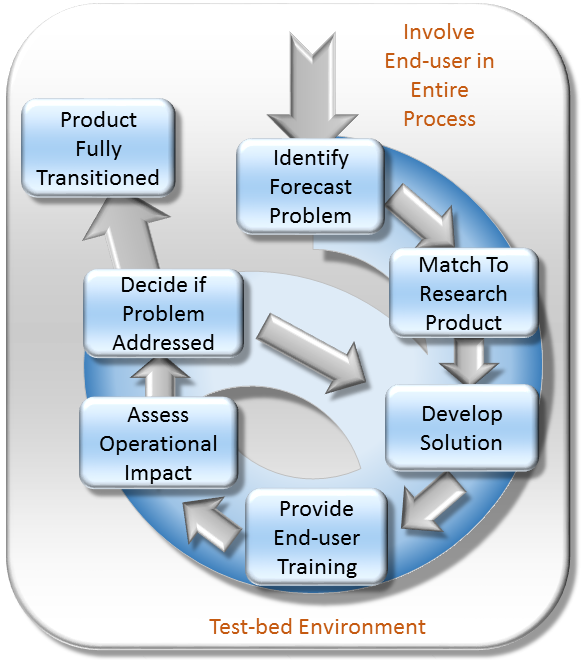
Part of SPoRT's philosophy with being a research and transition organization is to provide support to our collaborative partners. This support takes many forms and ranges from surveys of transitioned products, to in-person visits, to training on specific products. The ultimate goal is to not just provide a better product, but to provide a product that is valuable to the decision making process with our National Weather Service and other collaborative partners.
The training component is a vital piece in SPoRT's philosophy. Using new NASA Earth Observing System data sets, such as from the polar orbiting MODIS instruments to the total lightning network data, requires a shift in thinking from the tools currently available to operational forecasters. In order for a product to be successfully transitioned, SPoRT provides training to discuss the strengths and weaknesses of a product. Additionally, this training is built from the surveys provided by and direct communication with our partners. With this paradigm, the forecasters are an integral component of the transition process and not a passive recipient of data.
Training takes many forms. In a perfect world, in-person science sharing sessions would be done for every forecaster at every partner office. However, due to the nature of shift-work by our forecasting partners and the fact that SPoRT's partners are located throughout the country, in-person dialogue is not always possible. The next best thing is web-based training. The early training modules are simply power point presentations online. However, SPoRT is now in the process of creating complete audio and visual web-based training modules for SPoRT specific products. This provides a more in-depth training and allows a forecaster to follow the training at their leisure or to review the training when necessary.